Pull up a listing on the northwest side of Lincoln, somewhere near NW 48th and Holdrege, and you'll notice something odd if you cross-reference it against a second site. One calls it Arnold Heights. Another calls it Air Park. A neighbor down the street might call it Huskerville, and if you're near the newer stretch on the south end, you might hear Oak Hills instead. All four names point at the same general patch of ground, and none of them are wrong.
That's not a quirk. It's the actual naming history of the place, and it matters more than it should for anyone trying to figure out what a house here is really worth.
Why one neighborhood ended up with four names
The short version, laid out by Lincoln historian Jim McKee in the Journal Star: the land started as a municipal airport in 1928, became Lincoln Air Force Base during the Korean War buildup, and got developed with roughly 1,000 housing units built for military families using two different Cold War-era designs, Wherry Type and Capehart. When the base closed in 1966, the Lincoln Housing Authority took over the housing in 1970 and formally platted the area as Arnold Heights in 1971.
But the informal names never went away. The northern section is still referred to as Huskerville. The central section kept the Arnold Heights name. A newer, privately developed southern pocket goes by Oak Hills. And "Air Park" became the everyday shorthand locals use for the whole cluster, partly because it sits in the shadow of Lincoln Airport and partly because the name just stuck.
Here's where it gets practical. Property records, tax parcels, and most portals list the area as Arnold Heights. Longtime residents and plenty of local conversation call it Air Park. If you're comparing sale prices across sites, or asking an appraiser to pull comps, you need to know both names are pointing at the same streets, because a search using only one of them will miss listings under the other. It's a small friction, but it's the kind of thing that trips up out-of-town buyers and even some newer agents who assume the portal name is the only name.
The number that looks like decline, and isn't quite
Here's the part that actually changes how you should read this market. Recent local data puts the median sale price in Arnold Heights over the past twelve months at $195,750, which is down about 2 percent from the year before. On its own, that number reads like a soft market. Prices ticking down usually means buyers have leverage and sellers are waiting longer to close.
Except homes here are selling in about 30 days on average, compared to a 54-day national average. That's not a soft market. That's a market where nearly every reasonably priced listing gets snapped up before it has time to season. A shrinking median next to a fast turnover time usually means one of two things: either better-priced entry-level homes are pulling the median down while still moving quickly, or demand is outpacing what sellers are asking, and buyers are simply not waiting around to negotiate. Either read points the same direction. This is not a neighborhood coasting on inertia. It's one where the affordability story and the activity story are running in opposite directions, and the median alone won't tell you which one matters more for your specific search.
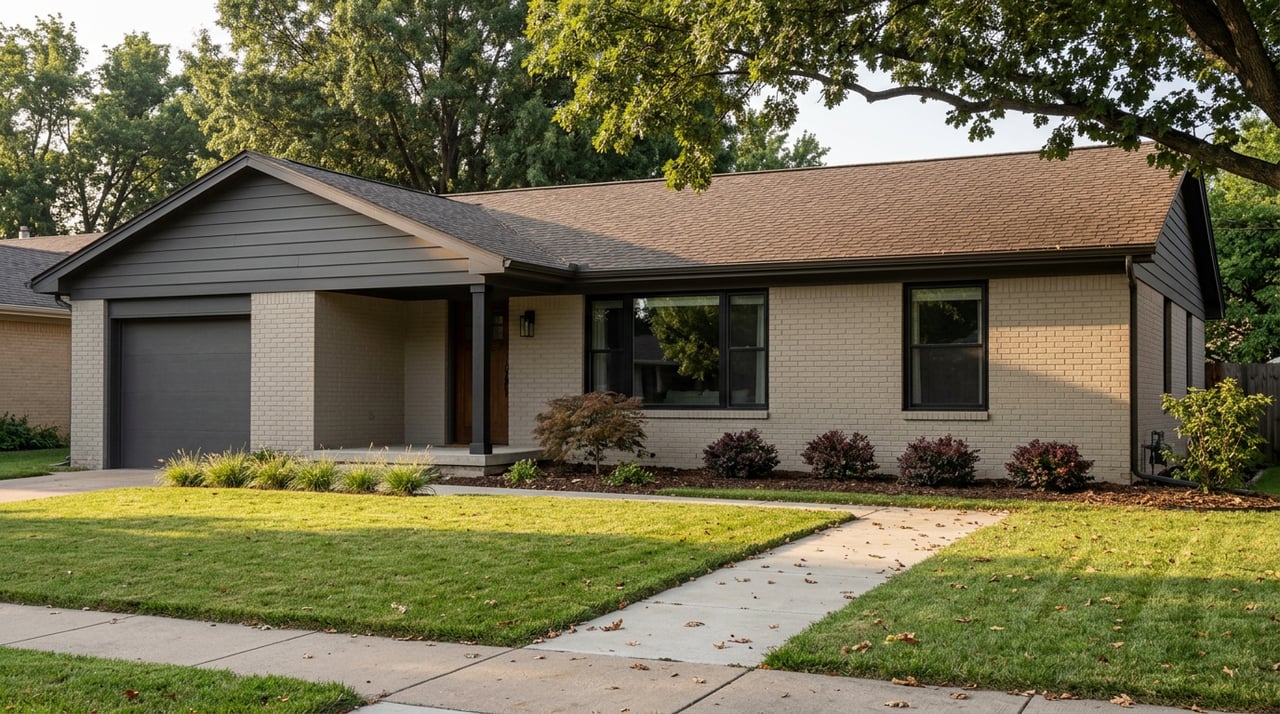
The housing stock backs this up. Most of what's for sale is ranch-style, built mostly in the 1950s, sitting on lots that run from a tenth of an acre up to a half acre, with prices spanning the mid-$100,000s to the upper $200,000s and no HOA fees to budget around. That's a genuinely different price point than the established, tree-lined blocks near Pioneers Park or the newer development pushing out toward the edges of town. If your budget caps out before six figures start climbing fast, this is one of the few corners of Lincoln where that ceiling still buys a single-family home with a yard.
What's actually happening two miles from these front doors
While the housing numbers hold steady, the airport next door is in the middle of the largest infrastructure project in its history. Lincoln Airport Authority is rebuilding Runway 18/36, a project running roughly $85 to $100 million depending on the source, funded through a partnership between the FAA and the Nebraska Air National Guard's 155th Air Refueling Wing. Construction started in January 2026 and is expected to wrap by fall 2027. The airport's own project page describes it as the largest undertaking in Lincoln Airport's history, replacing pavement that in places dates back to the mid-1950s.
Commercial service keeps running during construction, shifting between runways as each phase finishes. And the timing lines up with something else: American Airlines returned to Lincoln this year with nonstop service to Dallas-Fort Worth and Chicago O'Hare, plus seasonal flights to Phoenix, according to reporting from the Nebraska News Service. Airport officials have talked openly about trying to stop passenger "leakage," where Lincoln flyers drive to Omaha instead. The arrival of new nonstop routes alongside a nine-figure runway rebuild is not background noise. It's the kind of public investment that tends to draw private investment in its wake, though nobody can promise exactly when or how much.
I want to be careful here, because this is not a prediction about home values. Infrastructure spending at this scale sometimes precedes new commercial interest nearby, and sometimes it just modernizes what was already there without much ripple effect. What I can tell you is that this level of investment, this close to a neighborhood with genuinely affordable entry points and fast-moving inventory, is worth knowing about before you rule the area out based on its reputation alone.
The growth story that hasn't fully arrived yet
It's fair to temper the optimism a little. A few years back, developers pitched the Falcon Corner Redevelopment project on 43 acres near NW 48th and Interstate 80, aiming to open up land that had been held back by a lack of streets and difficult topography. The anchor tenant, Fleet Farm, backed out, and developers are still regrouping. Builder Bob Benes, who's putting up townhomes and single-family homes nearby at NW 45th and Holdrege, told the Journal Star he expects real growth over the next decade, but the commercial anchor that was supposed to kick things off hasn't landed yet.
So far, what's actually opened near Lincoln Northwest High School, which welcomed its first students in 2022, is more modest: a Sonic Drive-In and a Dollar Tree. Real progress, not a finished story.
What draws residents
Talk to people who live here and the pull isn't really about the airport or the runway. It's the school. Arnold Elementary sits close enough that many kids walk or bike, and a paved trail lets them avoid crossing the neighborhood's busiest street, NW 48th, on the way. An agent, based right here in Lincoln, has pointed to something simpler: being under a ten-minute drive from the airport adds a kind of everyday flexibility that's easy to overlook until you have it.
Add Arnold Heights Park, almost 18 acres with a play area and basketball court, and a City-run Air Park Community Center that's served the neighborhood since 1979, and you get a place that reads modest on paper and functions like a real neighborhood in practice.
What this means if you're comparing Lincoln neighborhoods
If you're cross-shopping northwest Lincoln against other parts of town, don't let the median price alone tell the story. Ask how long homes are actually sitting, check listings under both Arnold Heights and Air Park so you're not missing half the market, and factor in that a nine-figure airport project sitting two miles away is either about to change the neighborhood's trajectory or just modernize what's already here. Either way, you're buying into a place with more moving parts than its reputation suggests.
A few honest answers
Is Air Park the same neighborhood as Arnold Heights? Yes. Arnold Heights is the official platted name from 1971. Air Park is the name most locals actually use, and you'll also hear Huskerville for the northern section and Oak Hills for the newer southern pocket. All four describe the same general area.
Will the runway project make it noisier to live nearby? The airport has said commercial service continues throughout construction, shifting between runways as phases complete. Beyond that, there's no current local reporting quantifying a noise change for nearby homes, so it's a fair question to raise directly with the airport authority rather than assume either way.
Does the runway project mean home values will rise? Not necessarily, and I wouldn't treat it as a guarantee. What's true is that an $85 to $100 million public investment plus new nonstop flights is a meaningful signal of long-term commitment to the area. What it does to specific home values is something worth watching, not banking on.
If you're weighing a corner of Lincoln like this one against a more familiar part of town, I'd rather walk you through what the numbers actually mean than let a median price make the decision for you. That's the kind of conversation Miranda Watson has with buyers every week. Let's Connect and figure out what fits your search.
This article is general information, not legal, tax or financial advice. Consult a qualified professional about your situation.